

Bucks Magnet - Win Real Money
CazualLab
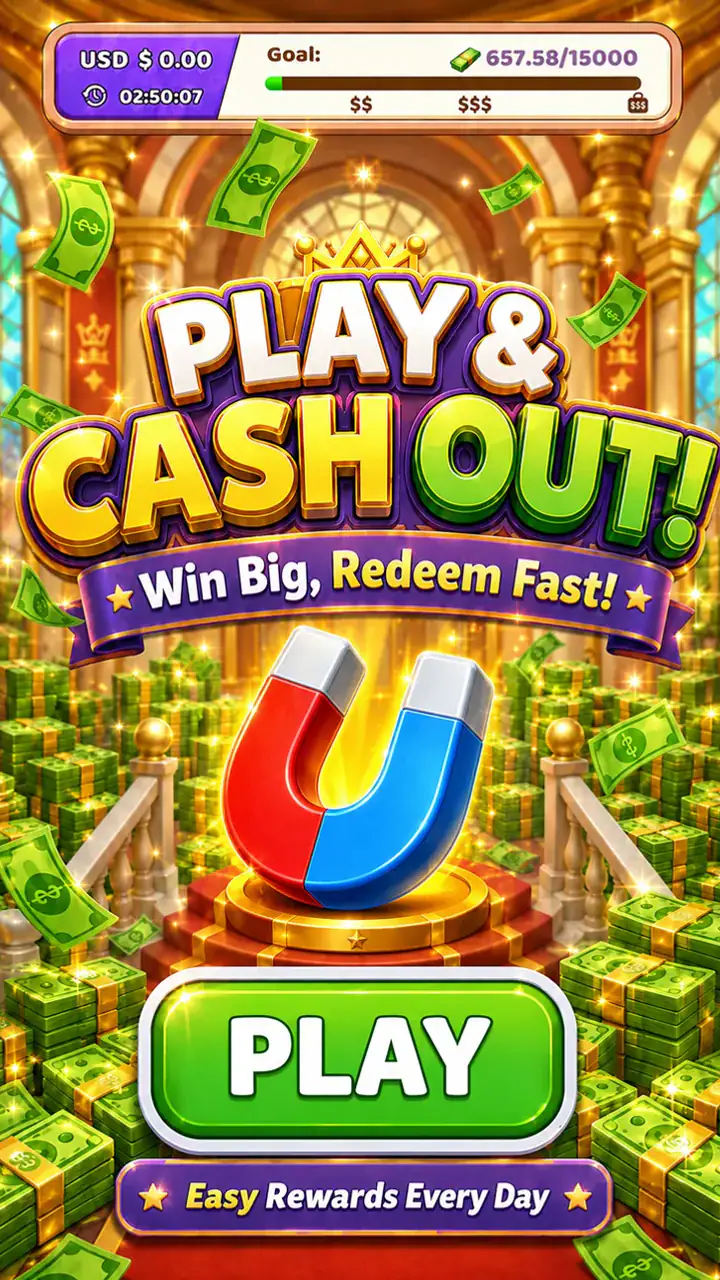
Bucks Magnet - Win Real Money is a simulation game built around one very specific promise: building up an in-game balance and reaching a cash-out point on a repeating three-hour rhythm. That focus makes it different from a typical city builder, idle tycoon, or management game, where the reward usually stays inside the game. Here, the idea of getting real money is placed at the center of the experience, so I approached it less like a conventional time-killer and more like a small routine to test carefully.
My first impression is that the concept is easy to understand. You are not being asked to learn a complicated fictional economy before seeing the point of the game. The appeal is immediate: open the game, work toward a larger balance, and check whether the cash-out cycle gives the experience a practical payoff. That simplicity is also its biggest challenge. A game built around one promise has less room to hide behind a deep story or a large collection of modes. If the earning loop feels satisfying, the whole product has a clear purpose. If it feels repetitive, the limited focus becomes noticeable quickly.
Why the three-hour cash-out idea changes the game
The important capability here is not merely that the game presents a number that goes up. It is the way the cash-out timing shapes how I use it. A normal simulation game encourages me to return whenever I feel like expanding a town, improving a business, or completing a personal objective. Bucks Magnet instead encourages planned check-ins. The three-hour interval turns progress into something I can fit around the rest of my day.
That rhythm can be convenient for someone who dislikes games demanding constant attention. I can treat it as a brief stop during a break, after lunch, or later in the evening rather than committing to a long session. At the same time, the schedule can make the game feel less flexible than an ordinary simulation. If I want a longer play session, the central reward cycle may not provide enough new material to keep me engaged for hours.
The phrase “real money” also changes the standard I apply. With a regular free simulation, repetitive actions are easier to forgive because the reward is entertainment. When a game connects its main appeal to cashing out, I naturally pay closer attention to the path between playing and receiving value. The experience needs to feel understandable and consistent. I want to know what I am working toward, what action moves me forward, and whether the cash-out moment is treated as a meaningful part of the design rather than a distant slogan.
Related News






That is why I would not judge this title only by the usual simulation questions, such as whether the graphics are elaborate or whether there are many buildings to unlock. The more useful question is whether the three-hour progress loop fits the way you already use your phone. If you enjoy short, repeated visits, the structure has a natural advantage. If you want a deep sandbox that rewards uninterrupted planning, the same structure may feel restrictive.
What the short-session structure feels like
In practice, the game is best understood as a routine rather than a marathon. I would open it with a specific purpose: check progress, perform the available actions, and decide whether there is a reason to return later. That mindset prevents the experience from becoming a vague promise that I keep checking without knowing why. It also makes the game easier to evaluate honestly, because I can separate the novelty of the money theme from the usefulness of the actual play loop.
A useful habit is to connect a session to something that already happens in your day. For example, you might check it during a regular afternoon break and again in the evening. This does not make the game more complex, but it does make the timing easier to remember. The trade-off is that a missed check-in can make progress feel slower, especially if you expected the app to function like a constantly active idle game.
Gallery
I also recommend keeping expectations measured. The title’s central promise is attention-grabbing, but a responsible player should treat any reward as something to verify through the in-game process rather than as guaranteed income. That is not a criticism of the concept; it is simply the sensible way to approach any entertainment app that connects gameplay with money. I would never install it assuming it can replace work, cover a bill, or produce dependable earnings.
The game’s simulation label matters here because it suggests a progress-oriented experience rather than a one-tap novelty. Still, the money angle is much more prominent than the fictional world-building that defines many simulation games. If your favorite simulations involve decorating spaces, managing staff, balancing resources, or watching a detailed environment develop, this may feel comparatively narrow. Its strength is focus, not breadth.
A realistic everyday use case
Imagine someone with a few spare minutes between ordinary responsibilities. They do not want a competitive multiplayer match, a story game that demands concentration, or a simulation that requires remembering a large network of upgrades. They want something simple to revisit, with a visible reason to return. For that person, the three-hour cycle can work well. A morning check, a later break, and an evening visit create a predictable pattern without taking over the day.
The same scenario also exposes the main limitation. If the player is busy, forgets the timing, or expects immediate results, the experience may feel underwhelming. The game is better suited to patient users who can accept gradual progress than to someone looking for a quick payout. I would especially avoid treating it as a task that must be checked obsessively. The value of the format is that it can fit around life; constantly monitoring it defeats that advantage.
Another practical point is device compatibility. The game supports Android devices running version 8.0 or later, which makes it accessible to many users with older phones, although compatibility still depends on the particular device and its current software condition. I would check the operating-system requirement before planning to use it on an older handset. That small step is more useful than assuming every Android phone can run it simply because the game appears lightweight.
Where the experience needs patience
The main friction is the gap between an attractive promise and the patience required by a timed progression system. “Get big real money fast” sounds immediate, while a repeating three-hour schedule naturally spreads progress across the day. Those two ideas can coexist, but they create a tension in the player’s expectations. I found it healthier to interpret “fast” as a simple route toward the goal, not as a guarantee of instant results.
The free price removes the initial financial barrier, which is important for anyone who wants to test the concept without paying upfront. It does not remove the need to spend time or to evaluate whether the routine is worthwhile. Free games can still cost attention, battery, and patience. In this case, the real question is whether the potential reward and the short-session format justify those costs for you.
I would also be cautious about using the game as a substitute for more established simulation titles. A traditional simulation usually offers a clear entertainment payoff even when progress is slow: you are building something, solving a management problem, or shaping a virtual space. Bucks Magnet places more weight on the outcome beyond the game. If that outcome does not interest you, there may not be enough secondary depth to keep you playing.
On the other hand, players who are tired of simulations filled with complicated menus may appreciate the narrower objective. There is less pressure to memorize systems or optimize a large virtual business. The trade-off is that simplicity can become repetition. I would give it a fair trial based on the core routine, not on the assumption that additional complexity will eventually appear.
How it compares with ordinary simulation alternatives
Compared with an idle tycoon, this game’s appeal is less about watching a fictional company expand and more about pursuing a reward connected to the player’s real-world expectations. An idle tycoon can remain satisfying even when the numbers are entirely imaginary because the growing business is the fantasy. Here, the balance has a more practical meaning, so the player may scrutinize every step more closely.
Compared with a city-building game, the experience is likely to feel less creative. City builders give me long-term projects, visual changes, and decisions that can be enjoyed even without an external reward. Bucks Magnet is a better fit when I want a focused routine rather than a large world to design. If creative control is the reason you play simulations, a conventional builder will probably offer more lasting variety.
Compared with reward-oriented apps that are not games, the simulation framing gives the activity a more playful identity. That can make repeated use feel less like completing a survey or checking a task list. The downside is that players may expect game-quality depth because it is labeled as a game. I would choose it over a purely functional reward app only if the simulation presentation makes the routine more enjoyable for me.
The most important comparison is therefore about motivation. Choose a normal simulation when you want a rich virtual project. Choose a reward-focused app when you want efficiency above all else. Choose this title when you want to test a money-centered game loop in short visits and are comfortable with gradual progress.
Small habits that make the concept easier to judge
My first tip is to establish a personal stopping rule. Decide in advance how often you are willing to check the game and how long you will test the routine. This prevents the promise of real money from turning into endless checking. It also gives you a clearer answer about whether the game fits your schedule rather than your curiosity.
My second tip is to separate balance growth from cash-out expectations. A rising in-game figure can feel encouraging, but it is not the same thing as money already received. Keep your attention on the actual steps required inside the game and treat the cash-out stage as the point that determines whether the routine is worthwhile. This distinction is especially important for younger players, who may read the promotional idea more literally.
My third tip is to use it as a companion activity, not your main game. A short visit during an existing break makes sense; replacing a favorite simulation with repeated checks may not. This approach also makes the trade-off clearer: you are testing whether the reward-focused loop adds something to your day, not forcing yourself to enjoy it because the promise sounds exciting.
Finally, keep the Teen content rating in mind when deciding whether it is appropriate for a younger person in your household. The rating is a useful reminder that the money theme and the surrounding game experience deserve an age-appropriate conversation. I would explain that a free game can be entertaining without being a dependable source of income, and I would encourage supervision where needed.
Who is most likely to enjoy it
The best audience is someone who likes simple progression, prefers short mobile sessions, and is curious about a simulation built around a real-world reward idea. That player can appreciate the clear objective without demanding the elaborate systems found in a full management game. The title also suits people who enjoy forming small phone routines and do not mind waiting between meaningful check-ins.
It is less suitable for players who need constant interaction, rapid action, or a strong narrative. It is also a poor choice for anyone searching for reliable income. The free entry makes experimentation easy, but it should not be confused with financial security. If your main goal is entertainment, a conventional simulation may give you more dependable value because its enjoyment does not depend on reaching a cash-out stage.
The developer, CazualLab, has positioned the game around a direct and memorable idea rather than a broad catalog of simulation systems. That focus has helped it attract a visible audience: it has passed one hundred thousand installs and holds a 4.7 average from around two thousand ratings. Those figures suggest that the concept has found interest, though popularity alone cannot tell me whether the routine will suit my own expectations.
The current release is version 1.0.2, so I would keep the app updated through the normal store process and judge the experience by the version actually installed on my device. I would also remember that early versions of focused games can feel more limited than mature alternatives. That is another reason to approach it as a specific experiment rather than as a complete replacement for every other simulation on a phone.
My recommendation after weighing the promise
I think Bucks Magnet is worth considering if the idea of a three-hour cash-out cycle genuinely appeals to you and you can approach it with patience. The free price lowers the risk of trying it, while the short-session design can fit naturally into a busy routine. Its clearest strength is that it gives a familiar mobile habit a concrete objective instead of asking you to manage an enormous virtual world.
My reservation is equally clear: the narrow focus leaves little room for disappointment. If the money-centered loop does not feel rewarding, there may be no deep city, story, or management system waiting to rescue the experience. I would not recommend installing it with the expectation of fast, dependable earnings. I would recommend it as a cautious trial for players who want to see whether a reward-driven simulation can become a pleasant part of their day.
In the end, Bucks Magnet - Win Real Money works best when I treat it as a timed mobile game with an ambitious reward concept, not as a job or investment. Its three-hour rhythm can be convenient, its free entry makes testing straightforward, and its focused design is easy to understand. For the right player, that simplicity is the attraction. For everyone else, a richer traditional simulation will probably provide more reliable entertainment.
FAQs for Bucks Magnet - Win Real Money
What is Bucks Magnet - Win Real Money?
Bucks Magnet - Win Real Money is a rewards-style mobile game that lets players collect virtual currency by completing simple activities, such as playing mini-games, reaching milestones, and viewing optional advertisements. The accumulated balance may be eligible for redemption through the payment methods supported by the app. It should be treated as entertainment with rewards, not as a guaranteed source of income.
Can I really withdraw money from Bucks Magnet?
The app may offer cash or gift-card withdrawals after you reach the required minimum balance and satisfy its eligibility rules. However, rewards apps can change their payment policies, processing times, available regions, and verification requirements. Before investing significant time, check the current withdrawal page, supported payment options, minimum threshold, and user reports to understand whether redemption is available in your country.
How do you earn rewards in Bucks Magnet - Win Real Money?
Rewards are generally earned by playing the available game modes, completing tasks, collecting bonuses, and sometimes watching advertisements. The exact earning rate can vary depending on your activity, promotions, account level, and location. Some offers may require additional conditions, so read the instructions carefully and avoid assuming that every displayed virtual reward can be converted into cash immediately.
Is Bucks Magnet - Win Real Money safe to use?
As with any rewards game, review the permissions requested during installation and avoid providing unnecessary personal information. Download the app only from an official store, use a unique password if an account is required, and never share payment credentials outside the app’s legitimate redemption process. Also review its privacy policy to learn how account, device, advertising, and usage data may be handled.
What should I know before downloading Bucks Magnet?
Bucks Magnet may be appealing if you enjoy casual games and do not mind advertisements, but the earning potential is usually limited and rewards can take time to accumulate. Confirm that the app is available in your region, check its latest ratings and reviews, and verify withdrawal conditions before starting. Do not pay fees to unlock rewards, and remember that results are not guaranteed.
Pros
- Simple gameplay makes it easy to start earning rewards quickly.
- Short sessions fit well into spare moments throughout the day.
- Multiple earning activities provide variety beyond the main game.
- Clear reward goals help users track their progress toward cashouts.
- Lightweight design should run smoothly on many Android devices.
Cons
- Earnings may be small compared with the time required to play.
- Cashout eligibility and minimum thresholds can limit quick withdrawals.
- Reward availability may vary by location or change over time.
- Frequent ads can interrupt gameplay and reduce the overall enjoyment.
- Some features may require personal information or account verification.


